Best AI Visibility & Prompt Tracking Tools (2026)


The best AI visibility and prompt tracking tools in 2026 are PromptWatch, Peec AI, Otterly.ai, Profound, AthenaHQ, and the AI modules inside Semrush and Ahrefs. Entry pricing starts around $29 per month and enterprise platforms run into four figures. For most B2B SaaS teams the right choice sits between $95 and $250 per month, because you need depth on 30 prompts rather than breadth across 500.
Your buyers are asking ChatGPT which vendor to shortlist, and you have no idea what it says. That is the entire reason this category exists. Twelve months ago there were a handful of tools doing this. Now there are more than forty, most of them launched in the last year, and the pricing pages are deliberately hard to compare because every vendor sells a different unit: prompts, responses, credits, projects or seats.
This guide covers six tools we consider worth your time, what each one costs, and the specific reason a B2B SaaS marketing team would pick it over the others. We run several of these for clients, so where we have an opinion from use rather than from a feature page, we say so.
What does an AI visibility tool actually do?
An AI visibility tool runs a fixed set of prompts through ChatGPT, Perplexity, Gemini and Claude on a schedule, then records whether your brand appears, how it is described, where you sit against competitors, and which source pages the model cited to build the answer. It is rank tracking for a world where there is no ranking, only an answer.
Four metrics matter, and every tool measures at least the first two.
- Mention rate. How often your brand surfaces across your prompt set. The blunt one.
- Share of voice. Your mention rate against named competitors on the same prompts. The one your board will ask about.
- Citation sources. Which third-party pages the model pulled from. This is the number that tells you what to actually do next, because it names the Reddit thread, review site or comparison page you need to influence.
- Accuracy and sentiment. Whether the description of your product is correct. In a technical category this matters more than mention rate, because being mentioned wrongly is worse than not being mentioned.
The mechanics underneath are retrieval, not memory, which is why the citation source data is the useful part. Our explainer on RAG and what it means for SEO covers why the model goes and fetches pages before answering, and what that means for the pages you own.
Why is prompt-count pricing wrong for niche B2B SaaS?
Most AI visibility tools price on prompt volume, which suits consumer and ecommerce brands and works badly for niche B2B software. A trainer brand can plausibly track 500 prompts because there are 500 ways to ask about trainers. If you sell transfer pricing software, there might be 30 questions a buyer would realistically ask an AI tool, and 12 of them are variations on the same thing.
That changes what you should buy. You do not need the tier with 350 prompts. You need daily refresh on a small set, proper citation source data, and the ability to see the actual answer text rather than a score. Buying breadth you cannot use is the most common mistake we see teams make in this category.
It also changes what good looks like. In a category with twelve vendors, a 40% mention rate is poor. In a category with 300, it would be excellent. Benchmark against your competitor set, not against a published average.
How we picked these six
We compared published pricing pages, engine coverage as stated by each vendor, and our own use where we have it. Four filters:
- Published pricing. Tools that will not show a number without a demo were marked down, with one exception noted below.
- Citation source data, not just mention counts. A tool that tells you that you disappeared without telling you who replaced you is half a tool.
- A sensible entry point. Anything with a four-figure floor was excluded unless it earned the place on capability.
- Evidence it is still the same product. This category is consolidating fast, and a tool acquired last quarter may not be the tool you trialled.
Prices below were compiled in August 2026 from public pricing pages and third-party comparisons. They move constantly. Check before you buy.
The 6 best AI visibility and prompt tracking tools
1. PromptWatch: best all-round pick for B2B SaaS teams
PromptWatch tracks brand mentions and citations across ChatGPT, Claude, Gemini, Perplexity, Google AI Overviews and Google AI Mode, with a per-prompt visibility score from 0 to 100 showing how prominently you appear. It reports pulling data from real user interfaces rather than vendor APIs, which matters because API output and what a human actually sees are not always the same thing.
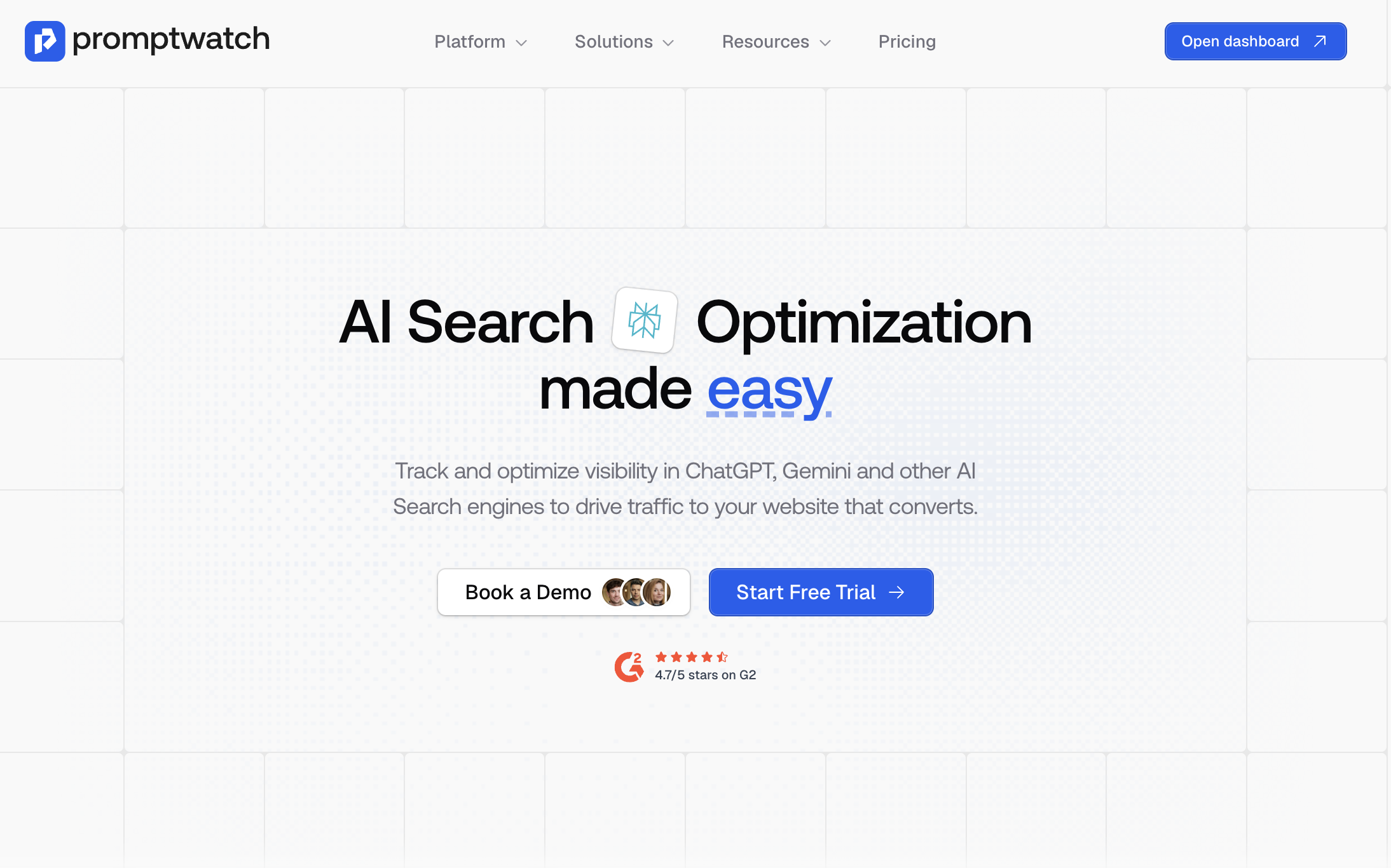
Best for: B2B SaaS marketing teams that want depth on a focused prompt set without enterprise pricing.
Pricing: free tier to start. Paid plans reported at roughly $95 to $99 per month for Essential (1 project, 50 prompts), around $245 to $249 for Professional (2 projects, 150 prompts, API access), and around $579 for Business.
Why we use it: the free tier means you can get a baseline before asking anyone for budget, and the Professional tier is the point where the data becomes useful enough to change what you publish. MCP and API access on entry plans is unusual in this category and makes it straightforward to pull the data into your own reporting.
Where it is the wrong call: it does no traditional SEO. No keyword research, no backlink data, no rank tracking. This is a second tool alongside Semrush or Ahrefs, not a replacement.
2. Peec AI: best for mid-market teams that want everyone looking at the same data
Peec AI focuses on clean citation and share-of-voice analytics with a project-and-country structure, and it does not charge per seat. For a marketing team where three or four people need access, that pricing model quietly saves a lot. The company reports raising $29M and passing $4M ARR inside ten months, so it is well funded and unlikely to disappear.
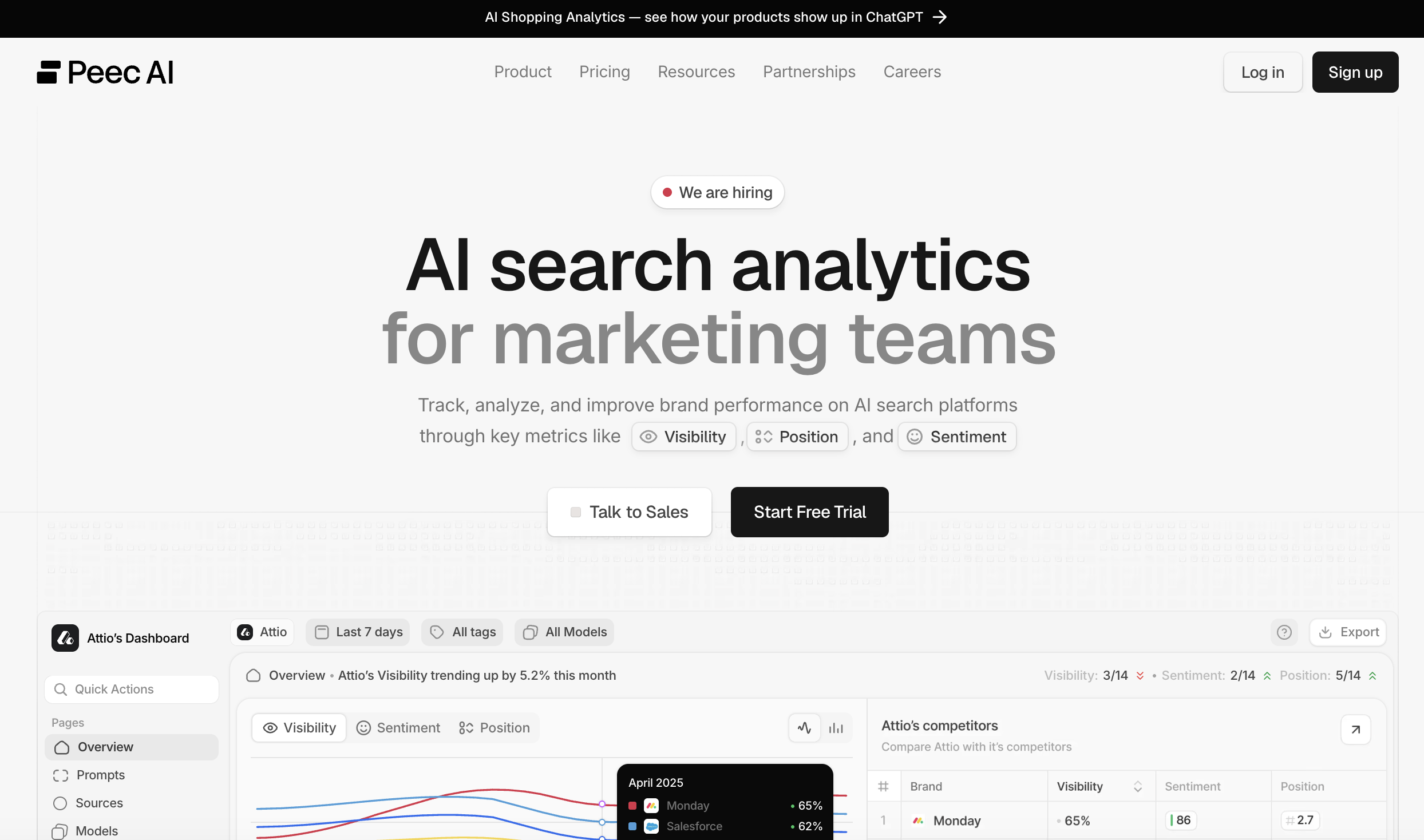
Best for: mid-market SEO and marketing teams, and agencies running several client accounts.
Pricing: Starter reported at €89 per month for 25 prompts, Pro at €199 for 100 prompts, with daily prompt runs. Enterprise adds 300+ prompts and SSO. Some sources quote $85 to $95 for the entry tier, so confirm on the pricing page.
Why it works: domain-level citation data is clean and the interface does not bury the answer text. Unlimited seats removes the usual argument about who gets a login.
Where it is the wrong call: broader engine coverage costs more once per-engine add-ons are included, so the headline price is not the real price if you need all four majors plus Grok and Copilot.
3. Otterly.ai: best cheapest way to get a baseline
Otterly.ai is the lowest-priced serious option in the category and was recognised as a Gartner Cool Vendor in 2025. The Lite plan gives you 15 prompts across four engines for $29 per month, which is enough to answer the only question that matters at the start: are we in the answer or not?

Best for: solo marketers, founders doing their own marketing, and anyone who needs a number to justify a bigger budget.
Pricing: Lite $29 per month for 15 prompts across 4 engines. Standard $189 and Premium $489 add prompts, API and MCP access.
Why it works: 15 prompts sounds thin until you remember that in a niche category you probably only have 30 worth tracking. Half your prompt set for £23 a month is a reasonable trade while you work out whether this channel matters to you.
Where it is the wrong call: the jump from Lite to Standard is steep. If you already know you need 50+ prompts, start at Peec or PromptWatch instead and skip the migration.
4. Profound: best for enterprise programmes
Profound is the most heavily funded company in the category, raising $96M at a $1B valuation in February 2026 for total funding of $155M, with a customer list that includes Target, Walmart, Figma, Ramp and MongoDB. It tracks up to 10 engines and its strength is source-level citation intelligence: not just which pages are cited, but the retrieval infrastructure shaping what gets pulled in the first place.

Best for: enterprise brands and large agencies with governance, multi-region and SOC 2 requirements.
Pricing: the Growth tier is reported around $399 per month billed annually, with Starter and Growth prices not always displayed in plain text on the pricing page. Enterprise is demo-gated and custom-quoted into the thousands.
Why it works: if your problem is genuinely one of scale (multiple brands, multiple markets, a compliance team asking questions), Profound is built for that and the others are not.
Where it is the wrong call: almost every B2B SaaS company below Series C. You will pay for coverage and governance you do not need, and the demo-gated pricing means a sales cycle before you find that out.
5. AthenaHQ: best for working out which third-party pages to influence
AthenaHQ was founded by former Google Search and DeepMind engineers and backed by Y Combinator. It monitors up to eight engines, and its distinguishing feature is source intelligence: identifying the specific URLs AI systems reference for your target prompts. That is the most useful competitive data in this tier, because it converts "we are invisible" into "we need to get onto these four pages". It also connects to GA4, so visibility ties back to something a finance director recognises.

Best for: teams whose GEO work has moved past measurement and into deciding where to spend effort.
Pricing: a free Essential tier exists. Self-serve Starter is reported at $270 to $295 per month on a credit model, with Enterprise custom.
Why it works: the free tier plus the source-level data is a strong combination for a team building the business case internally.
Where it is the wrong call: the credit model means monitoring cadence and AI-generated responses draw from the same pool, so monthly spend is harder to predict than a flat plan. Reports also suggest no free trial on the paid tier, so you commit off a demo.
6. Semrush AI Toolkit and Ahrefs Brand Radar: best if you already pay for the suite
If Semrush or Ahrefs is already in your stack, the cheapest credible AI visibility data is the module sitting inside the tool you have. Semrush's AI Toolkit is reported around $99 per month as an add-on. Ahrefs Brand Radar tracks a very large prompt database across ChatGPT, Perplexity, Gemini, Copilot, Grok and Google AI Overviews, and added YouTube, TikTok and Reddit source tracking in February 2026, at a reported €358 to €654 per month depending on tier.

Best for: teams with an existing suite contract who want the data without adding a vendor.
Why it works: no new procurement, no new login, and the AI data sits next to the keyword and backlink data it should be read alongside. For a lot of teams that convenience beats a slightly better standalone tool.
Where it is the wrong call: these are modules, not products. The depth is shallower than a dedicated platform and the roadmaps are not the company's priority. If AI search is becoming a real channel for you, you will outgrow them.
What we left off, and why
Scrunch AI was a strong mid-tier option and still shows well on features, but it was acquired by Sitecore in June 2026 for a reported $225 million and now sits inside a broader enterprise platform. It may well be the right pick if you are already a Sitecore customer. If you are not, understand what you are buying into before you sign a year.
Content platforms with GEO bolted on, including Frase and Writesonic, are genuinely useful if content production is your bottleneck. They are not the best measurement tools, and they will tell you they are because measurement is how they sell the writing.
Free graders and one-off scanners. A free AI visibility score is a lead magnet, not a measurement tool. It gives you a snapshot with no baseline, no trend and no competitor set. Useful for a first look, useless for reporting.
Which tool should you actually buy?
Start with the question you are trying to answer, not the feature list.
- "Are we in the answer at all?" Otterly Lite at $29, or the PromptWatch free tier. Get a baseline before you spend anything real.
- "How do we compare to our five named competitors?" Peec AI or PromptWatch Professional. This is where most B2B SaaS teams should land.
- "Which pages do we need to influence to fix this?" AthenaHQ, for the source intelligence.
- "We already pay for Semrush." Use the AI Toolkit for six months and see whether the channel justifies a dedicated tool.
- "We have four brands, three regions and a compliance team." Profound.
One caveat that applies to all of them. A tool tells you that you are invisible in AI answers. It does not make you visible. The work that changes the number is content, entity consistency and third-party sources, which is what generative engine optimisation actually involves. Buying a dashboard and changing nothing produces a very well-measured flat line.
If you want to run a baseline before spending anything, our guide to [Link: how to track AI search visibility -> https://www.team4.agency/post/how-do-you-track-ai-search-visibility] sets out the manual method: 10 to 20 prompts, run weekly, logged in a spreadsheet. It takes an hour a week and it will tell you whether a paid tool is worth it.
About Team 4
Team 4 is a B2B SaaS marketing agency based in London. We build Inbound Engines®, single systems combining SEO, GEO, content, paid media, CRO and analytics, measured against pipeline rather than traffic. We run AI visibility tracking on client accounts across construction technology, project and resource management, document management, tax technology, carbon accounting and promotional software for start-ups and enterprises alike.