
ChatGPT Ads: What B2B SaaS Needs to Know

ChatGPT Ads: What They Can Do, What They Cannot, and Whether B2B SaaS Should Care Yet
ChatGPT ads are sponsored cards that appear below ChatGPT's answers, sold through a self-serve Ads Manager since May 2026. They are matched to the topic of a conversation rather than to an audience, so there is no job title, company or firmographic targeting. For most B2B SaaS companies that makes this a small learning experiment rather than a pipeline channel.
Sam Altman spent two years telling people he did not want to put ads in ChatGPT. At Harvard in May 2024 he called the combination of ads and AI "uniquely unsettling". In February 2026 OpenAI shipped them anyway, and by May there was a self-serve buying platform with no minimum spend. So the question I keep getting from B2B SaaS founders has changed from "will this happen" to "should we be on it". This article answers that properly, including the parts the platform cannot do yet.
What Are ChatGPT Ads?
ChatGPT ads are paid placements that appear inside ChatGPT, matched to the subject of the conversation the user is having. They went from announcement to self-serve platform in under four months:
- 16 January 2026. OpenAI published its approach to advertising, setting out five principles and confirming testing would start with logged-in adults in the US.
- 9 February 2026. Ads went live for Free and Go users in the US.
- 26 March 2026. Expansion to Canada, Australia and New Zealand. OpenAI reported no measurable hit to consumer trust metrics and low dismissal rates.
- 5 May 2026. Self-serve Ads Manager opened in beta, with cost-per-click bidding added and the minimum spend removed entirely.
- 7 May 2026. Pilot expansion announced for the UK, Mexico, Brazil, Japan and South Korea.
If you have seen a date other than those, be careful. A lot of coverage collapses the announcement, the live test and the self-serve launch into a single event, and gets all three wrong as a result.
The commercial trajectory has been steep. OpenAI's pilot passed $100m in annualised revenue within roughly six weeks with more than 600 advertisers, and fewer than 20% of eligible users were being shown an ad on a given day (CNBC, March 2026, citing an OpenAI spokesperson). Read that second number again, because it is the most interesting one in this article. The inventory is mostly sitting empty.
Where Do the Ads Appear, and Who Actually Sees Them?
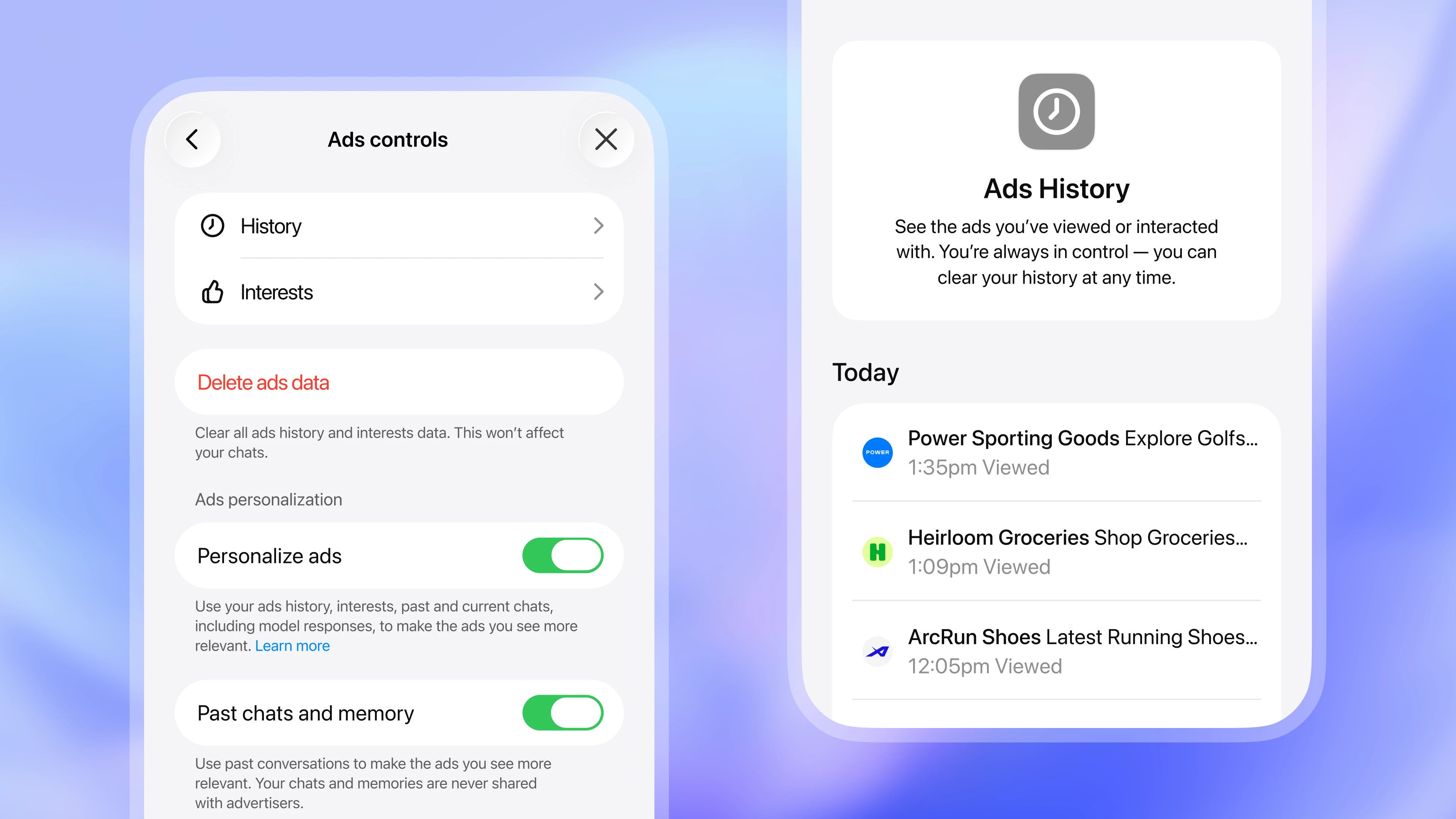
Ads appear below the end of a ChatGPT response, labelled as sponsored and visually separated from the answer. Each unit carries an advertiser name, favicon, title, description, image and landing page (OpenAI Help Centre, 2026).
Two things matter more than the format.
First, answer independence. Ads run on systems separate from the chat model, and advertisers cannot shape, rank or alter what ChatGPT says. You are buying a slot next to the answer. You are not buying the answer.
Second, and this is the one that should stop most B2B marketers in their tracks: ads only show on the Free and Go tiers. Plus, Pro, Business, Enterprise and Education accounts do not see them at all, and Free users can opt out in exchange for fewer daily messages (OpenAI Help Centre, 2026). Ads also do not appear in the ChatGPT Atlas browser during the test.
Think about where your buyers sit. The VP of Operations evaluating your platform on a company laptop is quite likely on a Business or Enterprise seat, which means she will never see your ad no matter what you spend. ChatGPT had around 900 million weekly active users as of February 2026, with 50 million-plus paying consumer subscribers and 9 million-plus paying business users (OpenAI, 2026). The headline user number is enormous. The addressable B2B advertising audience inside it is a fraction of that, and it skews away from the people signing purchase orders.
How Do You Buy ChatGPT Ads?
Through a self-serve Ads Manager at ads.openai.com, with no minimum spend since May 2026. The mechanics, straight from OpenAI's documentation:
- Objectives. Reach, paying per thousand impressions, or Clicks, paying per valid click.
- Bidding. A maximum bid set at ad group level. OpenAI recommends starting at $3 to $5 per click for Clicks campaigns.
- Auction. A relevance-weighted, second-price auction, so a tightly-scoped and genuinely relevant ad can win without the highest bid.
- Reporting. Impressions, clicks, spend, CTR, average CPC, average CPM and conversions.
- Plumbing. A measurement pixel, a Conversions API, an image tag and a full advertiser API, plus standard UTM support.
Pricing has fallen fast. The January pilot was reportedly pitched at around a $60 CPM with a $200,000 minimum commitment. By April the minimum was $50,000, and in May it went to zero. Reported CPMs drifted toward the mid-$20s over the same period, with B2B clicks running hotter at roughly $8 to $15 because the relevant pool is narrower. Those last figures are third-party observations rather than an OpenAI rate card, so hold them loosely.
Worth checking before you plan anything: OpenAI's ad policies prohibit political, adult, gambling, alcohol, tobacco and crypto advertising, and restrict finance, health and legal. B2B SaaS is generally eligible. Fintech, healthtech and legaltech should expect case-by-case review.
Can You Target B2B Buyers on ChatGPT?
No, and this is the single most important thing to understand about the platform. Targeting is contextual, not audience-based. You supply "context hints", which are plain-language descriptions of the conversations and topics where your product is relevant, and OpenAI's system matches ads against the intent of the current conversation, your landing page and ad copy, and (where personalisation is enabled) some signals from the user's broader ChatGPT history.
What you cannot do: target by job title, seniority, job function, company, company size, industry or account list. There is no firmographic layer and nothing resembling account-based marketing. OpenAI has said it is deliberately building guardrails to prevent narrow targeting, and advertisers never see conversations or personal details, only aggregate performance data.
Context hints are also explicitly not exact-match keywords, and OpenAI states they do not guarantee delivery in any specific conversation.
So compare the two positions honestly. On Microsoft Advertising you can layer LinkedIn company and job function data onto keyword intent. On LinkedIn you can buy job titles directly. On ChatGPT you can describe a conversation and hope the person having it works somewhere you care about. My take: that is a real limitation rather than an early-days quibble, and anyone selling you ChatGPT ads as a precision B2B channel either has not read the documentation or is hoping you have not.
How Do You Measure ChatGPT Ads?
Better than you might expect on tooling, worse than you need on verification. The pixel, Conversions API and UTM support mean you can wire ChatGPT ad clicks into your analytics and CRM properly from day one.
Two gaps matter. OpenAI's monetisation lead confirmed at the May launch that third-party measurement and cost-per-action bidding were still in development, with no named partners and no timeline. So you cannot yet optimise toward a target CPA, and you cannot independently verify what OpenAI reports.
The bigger problem is one you already have, whether or not you buy ads. ChatGPT traffic routinely lands in GA4 as direct, referral or unassigned unless you build a custom channel group for it, and app-based clicks often arrive with no referrer at all. Add a six-month B2B sales cycle and last-click attribution, and ChatGPT-influenced pipeline gets quietly credited to branded search. If you want to know how to fix that, we have written separately on how to track AI search visibility.
Three Things People Keep Getting Wrong About ChatGPT Ads
I have read a lot of coverage on this. Three errors recur often enough to be worth naming.
1. "It runs on Microsoft Advertising infrastructure." It does not. OpenAI built its own Ads Manager and its own auction, and its launch partners are Criteo, Dentsu, Omnicom, Publicis, WPP, Adobe, Kargo, Pacvue and StackAdapt. No Microsoft. The advertising organisation is staffed largely by ex-Meta people, including VP of Global Ad Solutions Dave Dugan. The Microsoft relationship covers Azure and revenue sharing, not ad serving. If an agency tells you your Bing campaigns can be imported into ChatGPT, they have invented that.
2. "Instant Checkout is ChatGPT advertising." It is not. Instant Checkout, built on the Agentic Commerce Protocol with Stripe, is a commerce and transaction-fee feature, and OpenAI pulled back toward a redirect model around March 2026. It is a different product with a different business model, and conflating the two makes the ad platform sound more mature than it is.
3. "ChatGPT traffic converts 5 to 20 times better than organic search." Those numbers are real but they describe the wrong thing. Ahrefs found AI-referred visitors made up 0.5% of sessions but 12.1% of signups. Seer Interactive measured ChatGPT referrals converting at 15.9% against 1.76% for Google organic. Every one of those studies measures organic citation traffic, meaning people who clicked a link because ChatGPT recommended you in its answer. None of them measures paid ad clicks. Do not put an organic conversion rate in a paid business case.
So Where Is the Actual Opportunity?
Three places, and I would rank them in this order.
- Under-priced inventory. Fewer than one in five eligible users was seeing an ad on a given day as of March 2026. Thin competition in B2B contexts plus a relevance-weighted auction means clicks may never be cheaper than they are now. If you can tolerate the measurement fog, there is a land-grab argument.
- High-intent conversational moments. Someone typing "best field service management tool for a 40-engineer team" into ChatGPT is further along than almost any display impression you can buy. A well-written context hint can put you next to that.
- Operational learning. Writing context hints, setting up the Conversions API and working out what creative lands are all skills with a lead time. Doing that at £4,000 rather than £40,000 has value.
Who should actually test it? Low-ACV, self-serve or product-led SaaS with a credit-card signup or free trial, selling to individual practitioners who plausibly sit on a Free or Go tier. Design tools, developer tools, productivity apps, SMB software. Who should ignore it for now? Sales-led enterprise SaaS with high ACV, committee buying and long procurement, where your buyers are on ad-free seats and your sales cycle outruns the reporting window.
One risk to weigh alongside the upside. An Ipsos survey of 1,085 US adults in late January 2026 found 63% said ads in AI search results would make them trust the results less, against 24% who disagreed. OpenAI reports no trust damage so far. Both things can be true early on.
How Does This Compare to Google, Microsoft and Perplexity?
For a B2B advertiser, ChatGPT currently has the biggest audience and the least useful ad product.
- Google AI Mode and AI Overviews. The most mature by a distance. Ads flow into AI surfaces through existing Search, Shopping and Performance Max campaigns, carrying Google's full targeting and measurement stack.
- Microsoft Copilot. The most B2B-relevant AI ad surface today, because it sits on Microsoft Advertising and can use LinkedIn profile data.
- Perplexity. Pioneered sponsored follow-up questions in 2024, stopped taking new advertisers in October 2025, and stepped back from advertising entirely in February 2026 to position itself as the ad-free option. Organic citation is the only route in.
- Claude. Anthropic has committed to keeping Claude ad-free and ran a Super Bowl spot in February 2026 making that its position.
The pattern is worth sitting with. Two of the four major assistants are competing on the absence of advertising. That is a signal about where user sentiment sits, and about how carefully OpenAI will have to tread.
What Should a B2B SaaS Team Do Right Now?
Five steps, in order. Only the last one involves spending money on ads.
- Prioritise getting cited over getting placed. Being recommended inside the answer is worth more than a card underneath it, and the conversion data above supports that even if it does not support the paid case. This is what generative engine optimisation is for.
- Fix your attribution this quarter. Build a custom GA4 channel group for AI sources, add a "how did you hear about us" field to demo and trial forms, and carry the source through to closed-won in your CRM. This pays off regardless of whether you ever buy an ad.
- Install the plumbing without spending. Put the measurement pixel and Conversions API in place, agree a UTM taxonomy and confirm your category is eligible. Then you can test on a week's notice rather than a month's.
- Understand where the demand is going. Paid search economics still carry most B2B SaaS pipeline, so read this alongside our B2B SaaS PPC strategy guide and our work on zero-click search .
- If you fit the profile, run a proper test. Roughly £4,000 to £12,000 over four to eight weeks, Clicks objective, context hints scoped tightly to bottom-of-funnel comparison conversations, judged on cost per qualified signup against your existing paid search CPA. Not impressions. Not clicks. Not CTR.
Then set your triggers for reassessing. I would revisit the moment any of these ship: third-party measurement, cost-per-action bidding, any form of firmographic or audience targeting, or ads reaching paid tiers. Until then this is a channel you watch closely and spend on lightly.
How Team 4 Thinks About ChatGPT Ads
Team 4 is not recommending ChatGPT ads to most of our B2B SaaS clients yet, and we would rather say that plainly than sell a test we do not believe in. The work that pays off now is getting cited in AI answers and making AI-sourced pipeline visible in the CRM, because both compound and neither depends on OpenAI shipping a targeting feature. For the minority of clients with self-serve products and low ACVs, we will run a scoped test and hold it to the same pipeline standard as every other channel. If it does not clear the bar, we turn it off and say so.
FAQs: ChatGPT Ads
Q: Are ChatGPT ads available in the UK?A: The UK was named in OpenAI's pilot expansion announced on 7 May 2026, following the US, Canada, Australia and New Zealand. Availability by country continues to change during the beta, so check OpenAI's Ads Manager availability page rather than relying on any article, including this one.
Q: How much do ChatGPT ads cost?A: There is no minimum spend since May 2026. OpenAI recommends a starting maximum bid of $3 to $5 per click for Clicks campaigns. Reported CPMs have fallen from around $60 at the January pilot toward the mid-$20s, and B2B clicks reportedly run higher at $8 to $15, though those figures are third-party estimates.
Q: Can you target job titles or companies on ChatGPT ads?A: No. Targeting is contextual, based on the topic and intent of the conversation plus advertiser-supplied context hints. There is no job title, seniority, company, industry or account-list targeting, and OpenAI has said it is actively building guardrails against narrow targeting.
Q: Do ChatGPT ads change the answers ChatGPT gives?A: No. OpenAI calls this answer independence. Ads run on separate systems from the chat model, advertisers cannot influence how responses are ranked or worded, and ads are labelled as sponsored and visually separated from the answer.
Q: Should B2B SaaS companies advertise on ChatGPT yet?A: Most should not spend meaningfully yet, because there is no B2B targeting and paying buyers on Business and Enterprise tiers never see the ads. Self-serve and product-led SaaS with low ACVs are the exception and can justify a small test. Earning organic citations is the higher-return priority for everyone.
About Team 4
Team 4 is a specialist B2B SaaS marketing agency based in London. We build Inbound Engines® for software companies from seed stage through to £10m+ ARR, combining SEO, GEO, content, Webflow development, paid media and analytics into one system measured against pipeline. Clients include Amazon Business, BigChange, Sitecore, AirDNA and Forecast.
.jpg)